Car Loan Finance Online Personal Loan Repayment Calculator
Calculate repayments with our Personal Loan Calculator. Compare loan terms, view repayment schedules, and plan your personal finance with confidence.
Calculator results are estimates based on the inputs and assumptions used and are provided for general information only. They are not quotes, offers, approvals, eligibility decisions or personalised recommendations, and do not indicate that a lender will provide credit. Actual repayments and costs may differ.
Personal Loan Details:
Important!
Personal Loan Interest Rates differ from lender to lender and will depend on your individual circumstances (credit history, employment status, age, etc.).
Personal Loan Amortisation Calculator
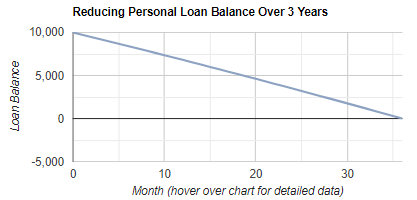
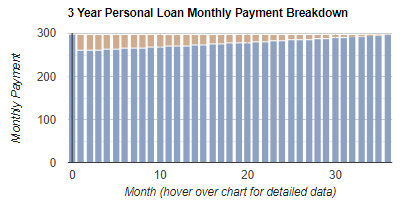
The following amortisation graphs detail month-by-month data on the progress of the proposed loan. The first chart below examines the reducing loan balance over the course of the finance contract term. The second graph illustrates the portion of each monthly repayment allocated to payment of interest vs principal reduction.
How to use our Personal Loan Repayment Calculator
Our Personal Loan Repayment Calculator helps you estimate your ongoing loan repayments and the total cost of borrowing before you apply. By adjusting the loan amount, loan term and interest rate, you can compare scenarios and choose a repayment level that better fits your budget. It also provides an amortisation view so you can see how each repayment is split between interest and principal over time.
Important note for ASIC compliance: this calculator provides general information only and does not take into account your objectives, financial situation or needs. Results are estimates and may not include lender fees, comparison rates, commissions, insurance, redraw features, or changes to your interest rate. Always check a lender’s final quote and loan contract before deciding.
How to complete the form for the best result
1. Loan Amount Required: Enter the total amount you want to borrow in Australian dollars as a whole number (no decimals or commas). Use the amount you actually need, not the maximum you might be approved for, to avoid overpaying interest.
2. Term of Loan: Select the number of years you plan to repay the loan over. A longer term can reduce the monthly repayment, but typically increases the total interest paid over the life of the loan.
3. Interest Rate: Choose an annual interest rate for the simulation. If you have a lender quote, use that rate. If not, test a conservative range to understand best case and worst case outcomes.
4. Calculate: Click the calculate button to generate your results.
How to interpret the results
1. Repayment estimate: Treat the repayment figure as your baseline commitment. Stress-test your budget by increasing the rate or shortening the term to see if repayments remain affordable.
2. Amortisation and graphs: Review the month-by-month amortisation view and charts to understand how the balance reduces and how early repayments often include a higher interest portion, shifting toward more principal over time.
3. Compare scenarios: Re-run the calculator with different terms and rates to balance affordability (cash flow) against total interest (overall cost).
Applying for a car loan in Australia usually involves checking affordability, preparing documents, submitting an application, lender assessment, conditional approval, vehicle checks, contract signing and settlement. This guide explains the typical steps and what can affect the outcome. - read more
Refinancing your car loan can be a game changer for your financial health. But what exactly does it mean? In simple terms, refinancing involves replacing your current car loan with a new one, usually to secure better interest rates or more favorable terms. - read more
The total cost of a car loan is shaped by more than the advertised interest rate. Learn how rates, fees, loan terms, deposits, balloon payments and repayment frequency can affect what you pay over time. - read more
Welcome to a beginner's guide to saving for your first car! Buying a car for the first time is an exciting journey, filled with anticipation and, sometimes, a bit of anxiety. Rest assured, you are not alone on this path. Many Australians have taken these steps before you, and with the right strategies, you can turn this experience into a rewarding achievement. - read more
ASIC’s latest review of mortgage broker conduct has put a spotlight on how loan recommendations are explained, documented and challenged when a cheaper option is available. Although the review focused on home loan brokers, the practical lesson is broader: borrowers should understand not only the advertised rate, but also why a particular loan structure, lender or feature is being presented as suitable. - read more
Australia’s electric truck conversation has shifted from vehicle availability alone to the practical question of where, when and how commercial vehicles will charge. Ampol’s October 2026 activity has made that shift clearer, with the company announcing a proposed acquisition of Evie Networks and a separate memorandum of understanding with Foton Mobility Distribution to explore charging solutions for electric commercial vehicles. - read more
ASIC’s 13 October 2026 review of major mortgage broker groups has delivered a timely reminder for borrowers: a loan recommendation should be understandable, evidence-based and clearly connected to the customer’s needs. The regulator found that broker practices generally aligned with its guidance, but also identified gaps in how some higher-cost loan recommendations, supervision processes and complaints were handled. - read more
Australia’s motorcycle market is ahead of last year after the first nine months of 2026, but the latest FCAI-audited figures point to a recovery driven mainly by off-road demand rather than a uniform lift across every type of bike. For riders thinking about motorbike finance, that distinction matters because the practical costs attached to a trail bike, junior motorcycle, scooter or road machine can look very different once purchase price, transport, gear, insurance and maintenance are considered together. - read more
Debt Consolidation: Taking advantage of lower interest rates that may be available by the grouping of multiple loans into one, lower interest rate loan.